<?xml version="1.0" encoding="utf-8"?><feed xmlns="http://www.w3.org/2005/Atom" ><generator uri="https://jekyllrb.com/" version="3.10.0">Jekyll</generator><link href="https://jalexine.github.io/feed.xml" rel="self" type="application/atom+xml" /><link href="https://jalexine.github.io/" rel="alternate" type="text/html" /><updated>2026-04-16T20:24:11+00:00</updated><id>https://jalexine.github.io/feed.xml</id><title type="html">♡ alexine</title><subtitle>&lt;p&gt; &lt;span style=&quot;color: #FFFFFF; font-size: 1.2em;&quot;&gt;上帝保佑你&lt;/span&gt; &lt;br&gt; Here&apos;s my only fixed address &lt;br&gt; i study ml and gpu programming &lt;br&gt; interned at datadom &lt;br&gt; always interested in working on cool projects : feel free to reach out! &lt;br&gt;  &lt;br&gt; &gt; on the way out &lt;br&gt;  &lt;br&gt; &lt;span style=&quot;color: #FFFFFF;&quot;&gt; &lt;span style=&quot;font-size: 40px;&quot;&gt;️ ☣ &lt;/span&gt; &lt;/span&gt;  &lt;a href=&quot;https://open.spotify.com/user/auwtkox85ovn7ahyyvuv64gql?si=cded6bf4e4ac4a8f&quot; style=&quot;color: #FFFFFF;&quot;&gt;
  &lt;span style=&quot;color: #FFFFFF; font-size:2em; font-weight:700;&quot; &gt;  listen to my sick playlists &lt;/span&gt; &lt;/a&gt; &lt;span style=&quot;color: #FFFFFF;&quot;&gt; &lt;span style=&quot;font-size: 40px;&quot;&gt;️ ☣ &lt;/span&gt; &lt;/span&gt; &lt;br&gt; &lt;br&gt; interest : bio/ml, computer arch, theology, philosophy, music, arts, poetry, opera, theater, horror, books, hiking, experiencing, learning... &lt;br&gt; &lt;br&gt; pure hate : journalism, ideology, &lt;a href=&quot;/assets/badfaith.pdf&quot; target=&quot;_blank&quot; style=&quot;color: #FFFFFF;&quot;&gt;this&lt;/a&gt;, advertising, 2-factor authentication, subscription culture and Microsoft   &lt;br&gt; &lt;/p&gt;
</subtitle><author><name>Alexine Le Port</name></author><entry><title type="html">on finding love</title><link href="https://jalexine.github.io/on-finding-love.html" rel="alternate" type="text/html" title="on finding love" /><published>2026-02-22T00:00:00+00:00</published><updated>2026-02-22T00:00:00+00:00</updated><id>https://jalexine.github.io/on-finding-love</id><content type="html" xml:base="https://jalexine.github.io/on-finding-love.html"><![CDATA[<p><span style="color:white"> I don’t like the usual discourse about dating and how you’re meant to optimize for it. So here are some thoughts on what love actually is and how you find it. </span></p>

<p><br /></p>

<p align="center">
<img src="assets/love1.jpg" alt="love1" width="200" style="height:auto;" />
</p>

<p><br /></p>

<p>Love can be hard and can fails because we ignore the mechanics of it. 
To build something that lasts, I believe love needs to meet two specific requirements:</p>

<ul>
  <li><strong>relationship craft</strong> :<span style="color:white"> the practical ability to build and maintain a healthy relationship </span></li>
  <li><strong>shared sensibility</strong> : <span style="color:white"> a similar way of perceiving and feeling the world</span></li>
</ul>

<p><br /></p>

<p align="center">
<img src="assets/love3.jpg" alt="brain" width="150" style="height:auto;" />
</p>

<p><br /></p>

<h2 id="-relationship-craft-"><span style="color: white;"> Relationship Craft </span></h2>

<p>Relationship craft is the ability to be a good partner and build something healthy. It means knowing how to communicate without turning every disagreement into a verdict, how to express what you feel, how to repair after conflict, and so on. It means being present not just when it is easy, but showing up consistently because you understand that love is something you build through action, something you choose every day. But none of this comes naturally. Before wanting to be in a relationship, there is necessary work to do on yourself. most people don’t see the work they need to do, ask around you. btw if you’re not mentally okay, dating is probably a bad idea because it will just drags someone else into it.</p>

<p><br /></p>

<p><br />
<br /></p>

<p align="center">
<img src="assets/love4.png" alt="eyes" width="200" style="height:auto;" />
</p>

<h2 id="-shared-sensibility-"><span style="color: white;"> Shared Sensibility </span></h2>

<p>I consider it to be the ability to have a similar perception of reality. You know when you look around and notice small details that feel like glitches in the simulation, something slightly off, poetic, or absurd.</p>

<p><br /></p>

<p><span style="color:white;"> <a href="https://www.gutenberg.org/ebooks/4352">We laugh when we detect rigidity inside life, when something mechanical interrupts what should be fluid.</a> </span> Love depends on the same sensitivity. It appears when two people respond to the world in a similar way, when the same kind of scene in a film stays with them, when a line in a book carries weight, when something ordinary suddenly feels charged.</p>

<p><br /></p>

<p>That is why a romantic gesture feels right with one person and uncomfortable with another. When you share something that moved you, it either reaches something already present in the other person or it does not. When that shared sensibility exists, the love that grows from it becomes specific, shaped by the way you both interpret what you see and feel. This sensitivity is innate and can not appear/change over time.</p>

<p><span style="color:white;"> You can grow, but the way you register the world tends to remain consistent. </span></p>

<p>We often think love is about “feeling” but a love that can last is actually about the logistical alignment of these two factors.</p>

<p><br />
<br />
<br /></p>

<p align="center">
<img src="assets/love2.jpg" alt="eyes" width="200" style="height:auto;" />
</p>

<p><br /></p>

<h2 id="-misalignment-"><span style="color: white;"> Misalignment </span></h2>

<p>In the beginning, what attracts us is almost always sensibility. We chase intensity because it gives the impression that something special is happening.</p>

<p><br /></p>

<p>But intensity does not automatically translate into durability. If two people have not reached a certain level of emotional maturity, the relationship can just become toxic and not last. What felt unique can slowly erode, not because it lacked depth, but because it lacked structure.</p>

<p><br /></p>

<p>With time, many people correct this. <span style="color:white;"> They work on themselves, learn to communicate better and become more stable. </span> At that stage, relationships become easier to maintain, yet something else often shifts: the search for shared sensibility becomes less central. Some people are tired and they just settle for stability. A relationship built this way can be healthy and functional, and for many that is enough. Tho from my experience i’ve met many guys crying after a few years because they thought that marriage will fix their life, it did not.</p>

<p><br /></p>

<p><br /></p>
<p align="center">
<img src="assets/love7.jpg" alt="love7" width="200" style="height:auto;" />
</p>

<p><br /></p>

<h2 id="-supermarket-mentality-"><span style="color: white;"> Supermarket Mentality </span></h2>

<p>Dating now runs on a supermarket mentality where people are consumed the way products are consumed. <span style="color:white;"> You scroll, you sample, you move on, always aware that there is another option waiting. </span> That logic changes the way you relate to others because instead of trying to understand how someone actually experiences the world, you assess whether they check enough boxes to justify staying. And then people complain that the dating market is broken. If every connection feels disposable, maybe the problem isn’t the market. Maybe it’s the way they approach it. Maybe they are the problem. If you keep going on dates and can’t build anything serious, at some point you have to question your own patterns.</p>

<p><br /></p>

<p><span style="color:white;"> A way to find love, I think, is by being yourself. The more you lean into who you really are, the activities you genuinely enjoy, the friends you naturally connect with, and the environments that feel right to you, the more likely you are to meet someone who truly matches you. I also think meeting people through friends or family is often better. </span></p>
<p><br />
<br /></p>

<p><br />
<br /></p>

<p align="center">
<img src="assets/love 6.jpg" alt="love6" width="200" style="height:auto;" />
</p>

<p><br /></p>

<p>&gt;Love obsesses humanity for a reason.</p>

<p>&gt;It runs through novels, films, religion, myths, because it touches something that cannot be reduced to strategy or compatibility.</p>

<p>&gt;We try to explain it, measure it, optimize it but it keeps escaping definition.</p>

<p><span style="color:white;">&gt;I often say that the more deeply you experience life, the closer you move toward God, toward a creator, and to me love represents the highest form of that experience.</span></p>

<p>&gt;It expands your perception, destabilizes your ego and connects you to something that feels larger than yourself.</p>

<p><br /></p>]]></content><author><name>Alexine Le Port</name></author><category term="example" /><summary type="html"><![CDATA[I don’t like the usual discourse about dating and how you’re meant to optimize for it. So here are some thoughts on what love actually is and how you find it.]]></summary></entry><entry><title type="html">on doing things</title><link href="https://jalexine.github.io/on-doing-things.html" rel="alternate" type="text/html" title="on doing things" /><published>2025-11-10T00:00:00+00:00</published><updated>2025-11-10T00:00:00+00:00</updated><id>https://jalexine.github.io/on-doing-things</id><content type="html" xml:base="https://jalexine.github.io/on-doing-things.html"><![CDATA[<p><span style="color:white"> It’s easy to get anxious just from scrolling.
Too much noise, too many people doing things, showing progress, achievements. It gives the illusion that everyone’s moving fast while you’re just there, watching. </span></p>


<p><img src="assets/boatdovier.gif" alt="bloodpoet" />
<em>Mattis Dovier</em></p>

<p><br /></p>

<h2 id="-complexity-"><span style="color: white;"> Complexity? </span></h2>
<p>Most of the fear comes from complexity. Complex things look scary from far away, equations in a paper, code, someone’s setup, someone’s work. The brain just shuts down and says I’ll never get there, but once the first step is done, once something actually starts, it’s never that complicated. It just looked that way.</p>

<blockquote style="color: white;">
“An idiot admires complexity, a genius admires simplicity, a physicist tries to make it simple.  
For an idiot, the more complicated something is, the more he will admire it.  
If you make something so clusterfucked he can’t understand it, he’s gonna think you’re a god because you made it so complicated nobody can understand it.  
That’s how they write journals in academics, they try to make it so complicated people think you’re a genius.”  
<br /><br />
<b>Terry Davis</b>
</blockquote>

<p>I like this quote from Terry Davis. Sometimes it’s just you being an idiot because you don’t have enough knowledge. Sometimes it’s certain people making things so complicated that you think <a href="https://en.wikipedia.org/wiki/Jacques_Lacan">they’re smart</a>.</p>

<p>The quiet truth is that most people don’t really do things. The bar is lower than it seems, in almost every field. Everything that looks impossible is usually just a matter of starting, of not stopping at the fear stage.</p>

<p><br /></p>

<p align="center">
<img src="assets/enigmatriz.jpeg" alt="enigmatriz" width="270" style="height:auto;" />
</p>
<p><a href="https://x.com/enigmatriz">Enigmatrix</a></p>

<p><br /></p>

<p><br /></p>

<h2 id="-start-"><span style="color: white;"> Start </span></h2>

<p>What helps is starting small, without overthinking the process. Pick a book and read just enough to understand the basics, then stop before it turns into endless theory. It’s not about finishing the book, it’s about reaching the point where you can actually try something. That’s where things start to make sense.</p>

<h2 style="color: white; font-size: 24px; font-weight: 600; margin: 0.5em 0;">
    <a href="https://docs.google.com/spreadsheets/d/10X-el41KoDluiC4ffXGL1wMDT8R2moOGPvdHE4j65nk/edit?usp=sharing" style="color: white; text-decoration: none;">
Here is a list of resources. If you can’t afford the books, you can find them on Libgen.
</a>
</h2>
<p><em>I will update the list; feel free to send me resources to add.</em></p>

<p>If you don’t yet understand what kind of project you want to do, that’s fine and part of the process. You’ll know what to do once you’ve gained enough knowledge.</p>

<p>Spend some time around people who actually build things. Follow them on <strong>X</strong>, read their stuff, try to understand how they think. Check GitHub, look at random repos, read the code, test small things, reimplement papers. At some point you’ll want to make something of your own, and that’s where real progress starts.</p>

<p><br /></p>

<p><br /></p>

<h2 id="-no-start-"><span style="color:white;"> No Start </span></h2>

<p>If you still can’t start, it might not be about motivation at all. Sometimes it’s your environment or your mental state. When you stay too long in the same place, surrounded by the same things, your brain starts to rot a bit. Everything feels dull and repetitive, like time isn’t moving. I saw many people trying to get out of this circle with journaling, trying pills, reading inspiring books.. one year later they’re still stuck..</p>

<p><br /></p>

<p>IMO 
Changing your environment helps. Clean your room, open the windows, change the light, throw away useless stuff. Make it a place where it feels possible to work. Add something nice, something that makes you want to sit there. Go outside more often, walk, listen to music, let your mind drift a bit. Sometimes ideas come when you stop trying to force them.</p>

<p><img src="assets/malkovich1.jpg" alt="malkovitch1" /></p>

<p><span style="color:white;"> You also have to ask if the direction you’re taking even makes sense, if the kid version of you would be proud. That question hurts a bit, but it’s useful, because it brings you back to what mattered before all the noise. </span></p>

<p><br /></p>

<p>And if nothing changes, maybe the issue is deeper: exhaustion, depression, burnout, or just being stuck for too long. In that case, the best move is to step away. Travel if you can, or just leave for a few days. Even a small shift breaks the loop. Don’t forget your brain’s tricking you. Just do things. We see losers making it every day, no reason you or me can’t.</p>

<hr />

<p>I hope this helps a few people. If it does, maybe just do something good with that energy, send a nice message, support someone on X, make it go somewhere useful.</p>]]></content><author><name>Alexine Le Port</name></author><category term="example" /><summary type="html"><![CDATA[It’s easy to get anxious just from scrolling. Too much noise, too many people doing things, showing progress, achievements. It gives the illusion that everyone’s moving fast while you’re just there, watching.]]></summary></entry><entry><title type="html">subscription culture sucks</title><link href="https://jalexine.github.io/subscription-culture-sucks.html" rel="alternate" type="text/html" title="subscription culture sucks" /><published>2025-10-28T00:00:00+00:00</published><updated>2025-10-28T00:00:00+00:00</updated><id>https://jalexine.github.io/subscription-culture-sucks</id><content type="html" xml:base="https://jalexine.github.io/subscription-culture-sucks.html"><![CDATA[<p><span style="color:white"> When did comfort start coming with a renewal date?
Everything you touch wants a subscription, even your bed..
</span></p>

<p align="center">
  <img src="assets/pintholo.jpg" alt="pintholo" width="270" style="height:auto;" />
</p>

<h2 id="-from-ownership-to-rentership-"><span style="color: white;"> &gt;From Ownership to Rentership </span></h2>

<p>Before, things lasted, you bought a machine, a phone, a bed, and it stayed for decades. You owned it. Then products started breaking on purpose. Planned obsolescence. Once durability stopped paying, fragility became the business model. Ownership turned into a problem, and companies realized that renting the same thing forever was more profitable than selling it once.i</p>

<p><br /></p>

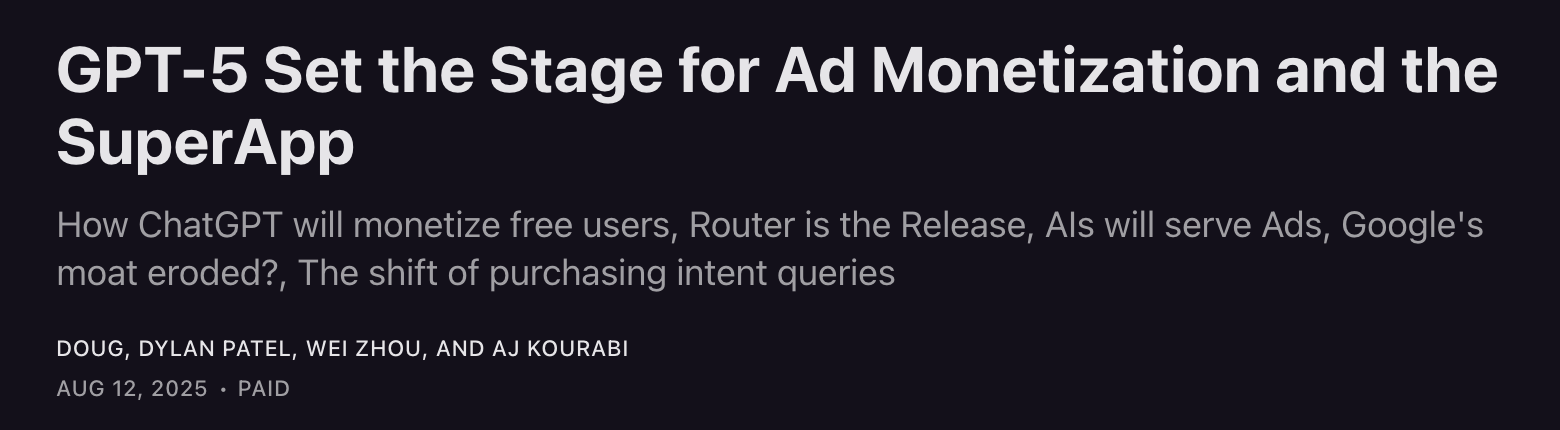
<p>It’s always the same story. Look at OpenAI. You really thought they would let you use it for free forever?</p>

<p><br /></p>

<p><img src="assets/gpt5monet.jpg" alt="gpt5monet" width="520" />
<a href="https://newsletter.semianalysis.com/p/gpt-5-ad-monetization-and-the-superapp">read it here</a></p>

<p><br /></p>

<p>That’s the <a href="https://en.wikipedia.org/wiki/Bait-and-switch">bait and switch</a>. They start solid, reliable, often free, then quietly turn it into a subscription. Everything becomes a subscription, EVEN YOUR BED (Eight Sleep). why am i paying every month for an ink-tablet….
<br /></p>

<p>The idea of paying often isn’t new, but it became invisible. Before, marketing played with numbers: 10 became 9.99, to make you feel like you were spending less. Now it plays with time. Instead of paying once, you pay forever, but in amounts too small to notice. A few dollars a month, quietly taken, no decision required.</p>

<p><br /></p>

<p>It was sold as flexibility, <span style="color:white;"> “cancel anytime,” but that’s just a new disguise for commitment and auto renewal does the rest, removing the moment where you choose. And when prices go up, you stay. Your data, your setup, your history, all trapped inside convenience. You could leave, but you won’t.</span></p>

<p><br /></p>
<h2 id="-the-disappearance-of-marketing-"><span style="color: white;"> &gt;The Disappearance of Marketing </span></h2>

<p>Advertising used to be loud. Billboards, TV spots, big fonts, big promises. You could ignore it, mock it, hate it, but at least you knew what it was. Now it’s invisible. It doesn’t sell, it belongs. Brands talk like people. They post memes, reply to jokes, pretend to be part of your world. They call it community, but it’s really proximity. Marketing stopped knocking, it moved in.</p>

<p><span style="color: white"> Modern marketing doesn’t look like ads anymore. It hides behind creators, ambassadors, brand families. It talks about identity, values, emotions. It pretends to care. It doesn’t want to convince you, it wants to be you. It builds intimacy, then feeds on it. </span></p>

<p><br />
We use large language model everyday, owned by big closed compagnies, we are slowly allowing them to shape what we read, suggest what we think, decide what we like. They’ll market through us, not to us. And we won’t notice the line between opinion and influence disappearing. It already starts through social media algorithms and it already has consequences…</p>

<p><br /></p>

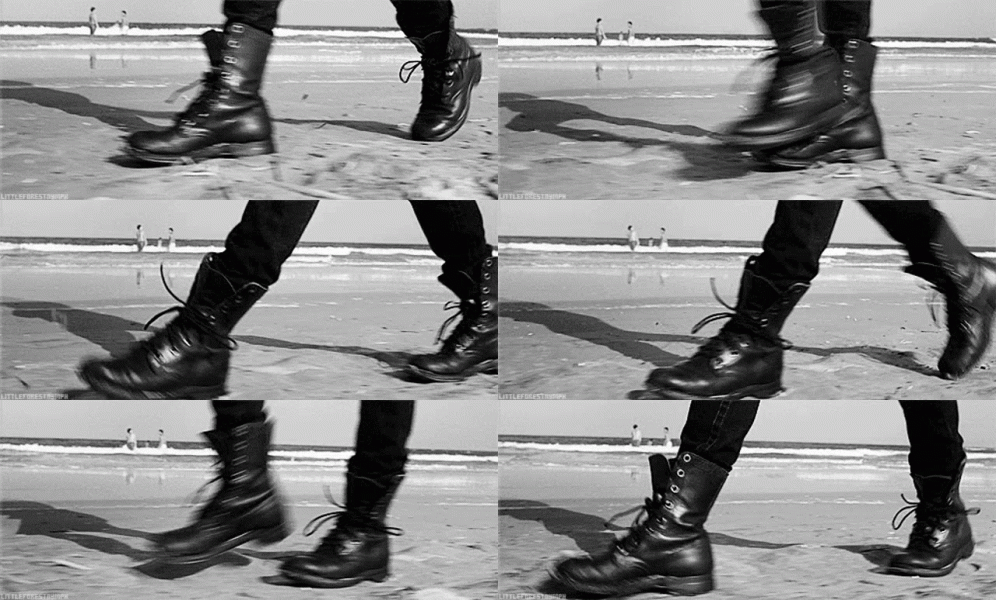
<p><img src="assets/boots.gif" alt="boots" width="420" /></p>

<p><br /></p>

<p>What’s funny is how the resistance disappeared too. The people who used to fight ads, punk kids and leftists who tore down billboards, now just want to be represented in them. :)</p>

<p><br /></p>

<h2 id="-personalization-as-manipulation-"><span style="color: white;"> Personalization as Manipulation </span></h2>

<p>After belonging came emotion. The system learned how to look back at you. Algorithms started showing what feels personal, music that matches your taste, clothes that fit your style, news that fits your mood. It feels intimate, almost caring. <span style="color: white;"> The machine understands you. </span></p>

<p><br /></p>

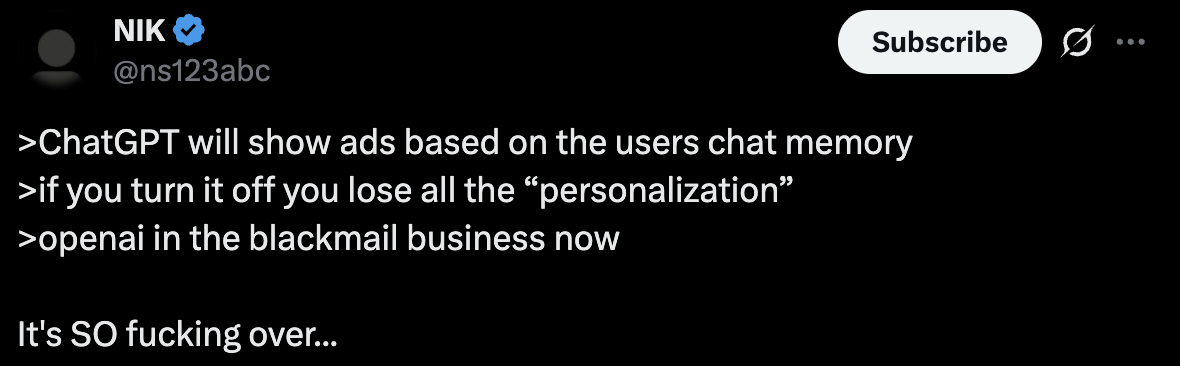
<p>But that’s the point. Personalization isn’t made to only please you, it’s made to keep you or generate more money. Every choice, every click, every scroll helps it rebuild you in its own format. Either their having more control on you or they sell this control</p>

<p><br /></p>

<p><img src="assets/niktweet.jpg" alt="nikthebest" width="620" />
<a href="https://x.com/ns123abc/status/1981816923974512698">NIK’s tweet</a></p>

<p><br /></p>

<p>Leaving feels wrong because it feels like leaving yourself. Your playlists, your data, your saved settings, all stored somewhere else. These systems remember you better than you do. You stay, not because you want to, but because leaving means starting over from nothing.</p>

<p><br /></p>

<h2 id="-notallofthem-"><span style="color: white;"> #NotAllofThem </span></h2>

<p>Not every subscription is a scam. The model itself isn’t evil, it just got hijacked. Some subscriptions actually free people like when you support a small creator, a researcher, or a writer, you’re not feeding the system, you’re funding independence.</p>

<p><img src="assets/greens.gif" alt="green" width="320" />
<br />
You’re helping someone stop depending on middlemen, sponsors, or corporations, and that’s not exploitation, that’s actually redistribution. A good subscription gives someone enough stability to earn back their time, or to share it, by helping others or supporting causes that matter.</p>

<p><br /></p>

<p>But a bad one is when the money goes to people with influence who don’t create any real value and who use their reach to feed themselves, not to build anything, not to help anyone, not to create actual value. We give too much importance to these people (subscription or not).</p>

<p><br /></p>

<p><br /></p>

<p><span style="color: white;"> Maybe it’s time to check your list of subscriptions and cancel a few.
  Anyway, you can still subscribe to mine on X
 </span></p>]]></content><author><name>Alexine Le Port</name></author><category term="example" /><summary type="html"><![CDATA[When did comfort start coming with a renewal date? Everything you touch wants a subscription, even your bed..]]></summary></entry><entry><title type="html">i dyed my hair pink because i’m mentally stable</title><link href="https://jalexine.github.io/i-dyed-my-hair-pink.html" rel="alternate" type="text/html" title="i dyed my hair pink because i’m mentally stable" /><published>2025-09-17T00:00:00+00:00</published><updated>2025-09-17T00:00:00+00:00</updated><id>https://jalexine.github.io/i-dyed-my-hair-pink</id><content type="html" xml:base="https://jalexine.github.io/i-dyed-my-hair-pink.html"><![CDATA[<p><span style="color:white"> The dye stained the sink, my palms, the edge of the mirror. I watched the pink foam run down the drain and thought: well, this is what stability looks like now.</span></p>

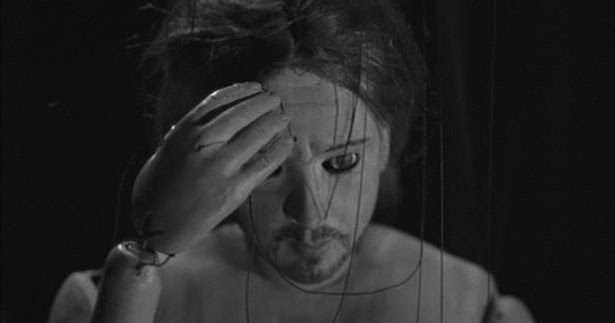
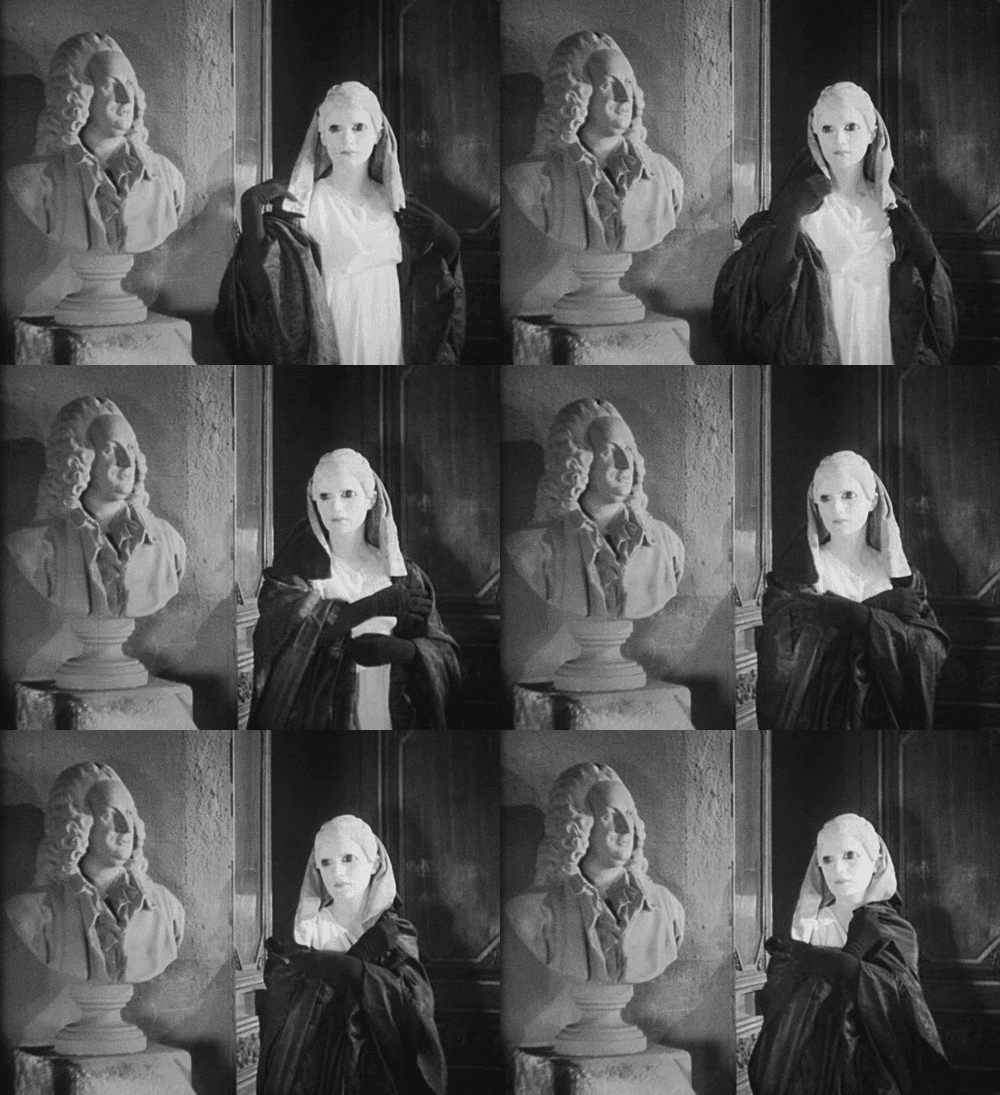
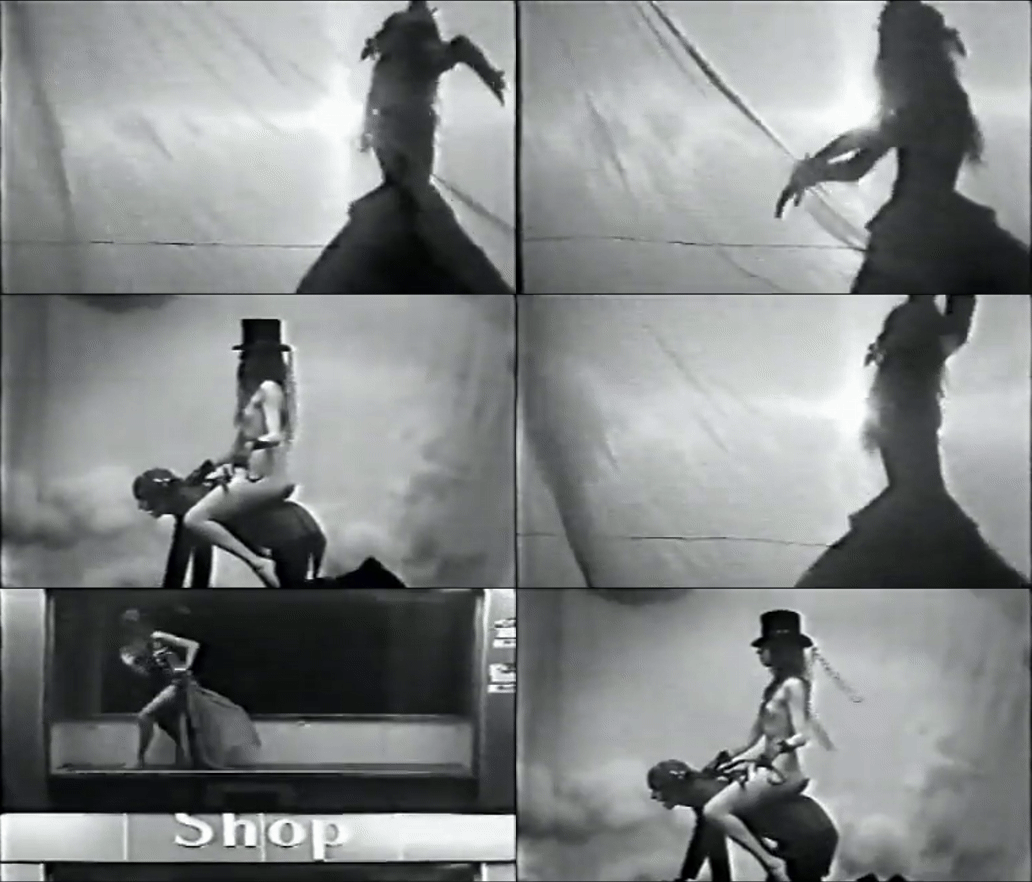
<p><img src="assets/bloodoapoet.gif" alt="bloodpoet" />
<em>The Blood of a Poet (1930), Jean Cocteau</em></p>
<h2 id="facing-the-self"><span style="color: white;">Facing the self</span></h2>
<p>I’ve worn many identities, legal or not. Masks, reset buttons, quick escapes. Change my name, cut my hair, switch styles like outfits. I grew up between worlds, with a mind that didn’t fit where I came from and means that didn’t fit where I wanted to go. So I followed whatever each experience had to offer, learning that the easiest way to adapt was to blur myself, to shift just enough to fit. I kept what I loved hidden, as if secrecy made it safer.
I always said I wanted to experiment more in life, because it brings you closer to reality, closer to god, though at the same time it pushes you further away from people.</p>

<p>What is it that we call identity: a name, a memory, a role we play, or something deeper that resists all change, something that endures beneath every mask. How would you define yourself.</p>

<p>When you lose track of who you are, the only compass left is often the <a href="https://open.spotify.com/playlist/35UYaYtPFYE5veGkzw50Sk?si=bebb454c4bab4ef1">child you once were</a>. What did you dream of then, and would that child be proud of you now?</p>

<p>I was thinking about it. 
When I was growing up, my idols were always women who felt like they were burning from the inside out. <a href="https://www.youtube.com/watch?v=b_8U93SvVyY&amp;list=RDb_8U93SvVyY&amp;start_radio=1">Brody Dalle</a>, <a href="https://www.youtube.com/watch?v=cH_rfGBwamc&amp;list=RDcH_rfGBwamc&amp;start_radio=1">Courtney Love</a>, <a href="https://www.youtube.com/watch?v=82P40PnMNmQ&amp;list=RD82P40PnMNmQ&amp;start_radio=1">Katie Jane Garside</a> …</p>

<p>Unstable, loud, magnetic. That, to me, was freedom.</p>

<p><img src="assets/queenadreena.gif" alt="queenadreena" /></p>

<p>Madness has always been close, an allure I could never ignore, yet in recent years it turned to fear, enough to mistake difference for its symptom and bend myself into conformity. Seeing what others cannot is a dangerous gift, a vision that can lead either to clarity or to the fall, and nothing in it is absolute, because its shape always depends on the world one moves through, a world where difference becomes illness only because <a href="https://monoskop.org/images/b/b6/Canguilhem_Georges_The_Normal_and_the_Pathologic_1991.pdf">others have chosen another norm</a>.</p>

<p><br /></p>

<h2 id="facing-the-world-"><span style="color: white;">Facing the world </span></h2>

<p>It always felt like <a href="https://pubmed.ncbi.nlm.nih.gov/14781229/">too much</a> for people to handle. Somewhere along the way, passion got lost. Life never felt like the books or movies, yet inside me it burned with the same weight as <a href="https://en.wikipedia.org/wiki/The_Sorrows_of_Young_Werther">Werther’s longing</a> or the fierce loyalty of Pushkin’s <a href="https://en.wikipedia.org/wiki/The_Captain%27s_Daughter">Captain’s Daughter</a>.</p>

<p>Love never felt this way.</p>

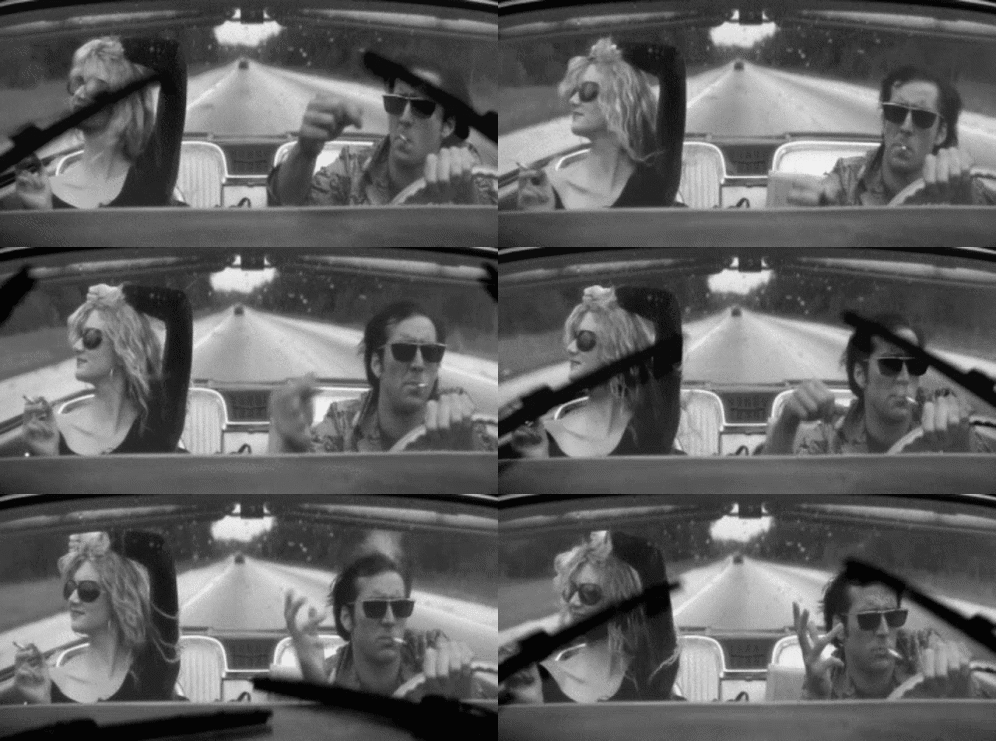
<p>Not as fragile like <a href="https://www.imdb.com/title/tt0424880/">Candy</a>, not as intimate and raw like Gaspar Noé’s <a href="https://www.imdb.com/title/tt3774694/">Love</a>, not as poetic like <a href="https://en.wikipedia.org/wiki/Mood_Indigo_(film)">Froth on the Daydream</a>, not wild and free like <a href="https://en.wikipedia.org/wiki/Wild_at_Heart_(film)">Wild at Heart</a>, not timeless and artistic like <a href="https://en.wikipedia.org/wiki/Only_Lovers_Left_Alive">Only Lovers Left Alive</a>.
I also found the story between Caroline and Fred in <a href="https://mogami.neocities.org/files/prime_intellect.pdf">The Metamorphosis of Prime Intellect</a> very romantic.</p>

<p><br /></p>

<p><img src="assets/wildatheart.gif" alt="wildatheart" /></p>

<p><br /></p>

<p>Maybe that is why we get lost. We carry dreams that never quite match reality, and the collision leaves us hollow. In the silence that follows, we reach for what is closest, copying the gestures around us, and soon we mistake imitation for direction. Passion fades, routine takes its place. Most days slip away in work that feels detached from meaning. Money is never the real measure. The real question is simple. <span style="color:white"> Do you actually create value.</span></p>

<blockquote><em style="color:#fff">Sitting in a chalet in the backyard with a laptop, a little girl hating Windows and dreaming of building a computer and an operating system no one could ever track. She was growing up with a keylogger. The dream never happened. For ten years she didn’t touch a computer.</em></blockquote>

<p>I’ve come to think that honoring life means trying, in whatever way possible, to make the world a little better. I remember how we once looked at it with clear eyes and felt the weight of its injustice, and from that wound came the dream of building something better. That dream was never naïve, it was the only honest vision we ever held.</p>

<p><span style="color:white">
History itself is written in architectures, from cities of stone to machines of code. We can build, we can arrange, but we cannot create like God. 
</span></p>

<p>I have always been obsessed with creation. I wrote a thesis on it. Yet what we call creation is never the world itself, only a way of reaching closer to its source. Every attempt is a fragment, a reflection of something we can sense but never fully grasp. There is something about computers that fascinates me for this reason, as if through them we were tracing the outlines of a truth older than us.</p>

<p><br /></p>

<p>The era of the nonchalant gimmick is fading.</p>

<p><span style="color:white"> The future belongs to those who care deeply</span>, who are not afraid to show the weight of their effort. Indifference will not survive. 
The world needs to move toward authenticity, and what will set us apart is how much of ourselves we give.</p>

<p>I want to walk that path, to hold on to love, to create value, and to let my life unfold in its own form, never as a sellout again.</p>]]></content><author><name>Alexine Le Port</name></author><category term="example" /><summary type="html"><![CDATA[The dye stained the sink, my palms, the edge of the mirror. I watched the pink foam run down the drain and thought: well, this is what stability looks like now.]]></summary></entry><entry><title type="html">Seventeen On The Road</title><link href="https://jalexine.github.io/seventeen-on-the-road.html" rel="alternate" type="text/html" title="Seventeen On The Road" /><published>2025-08-19T00:00:00+00:00</published><updated>2025-08-19T00:00:00+00:00</updated><id>https://jalexine.github.io/seventeen-on-the-road</id><content type="html" xml:base="https://jalexine.github.io/seventeen-on-the-road.html"><![CDATA[<p>Over drinks the other day, <a href="https://x.com/deepfates">Deepfates</a> and I realized we’d both lived in anarchist communes, his in the US and mine in Europe. Same Rainbow ideas, but the realities couldn’t have been more different. He had lived through infections and hygiene problems I never encountered. He even wrote about it in <a href="https://www.emilybynight.com/p/the-politics-of-contagion"><em>The Politics of Contagion</em></a>, published in <a href="https://www.emilybynight.com/"><em>The Ick</em></a>. It’s a pretty cool magazine, you should check it out. It reminded me that even at the edges of society, life felt cleaner in Europe than in the US. So I want to tell you about my experience.</p>

<blockquote style="color:white;">
  “I swear I'll run away from every home I ever have<br />
  So I'll build a new house in every town I pass<br />
  Maybe then I won't always feel lost and trapped.”
  <br /><br />
  — <em>Wingnut Dishwashers Union, “My Idea of Fun”</em>
</blockquote>

<p>I was seventeen, fresh out of foster care and starting to sleep rough. Running away felt less like a decision than the only option left.<br />
One dusk in central France, I crossed paths with a barefoot guitarist who seemed beamed in from 1969. He spoke of <a href="https://en.wikipedia.org/wiki/Rainbow_Gathering">Rainbow Gatherings</a>, month-long roving encampments descended from Woodstock’s hippie diaspora.</p>

<p>So I set out to find one. I spent a year and a half on the road. I traveled the world looking for understanding of the times that we live in.</p>

<p><img src="assets/mapix.jpg" alt="mapix" /></p>

<p style="color:white;">
First, I hitchhiked nearly 1,500 miles from France to Bulgaria.
</p>
<p>Risky, sure, but I made it, and met kind people along the way. The trip took me four days.</p>

<p>The coordinates are never printed, only whispered: look for a meadow, a stream, a ring of forest.</p>

<p><br /></p>

<p><span style="color:white">No phones, no booze, no hard drugs.</span></p>

<p><br /></p>

<p>Trust was the local currency, and everyone spent it freely. Strangers would lend out their cars or lose a whole afternoon helping you pitch a tarp, no questions asked. I was starved for that kind of gentleness. I needed proof that people could still be decent, the Rainbow gave me that.</p>

<p><br /></p>

<p>My first task was to set up camp. I arrived with a flimsy tent, but by the second gathering I was building huts from branches and mud. Completed with a campfire, a guest room, a pebble path, and a hand-painted sign bearing my name. My dad used to be a conspiracy theorist and had drilled <a href="https://www.amazon.com/Wilderness-Survival-Guide-Practical-Outdoors/dp/1907486046">survival skills</a> into me “for when society collapses.” Turns out those lessons paid off: soon I was firing clay pizza ovens and sparking flame in the rain.</p>

<p>Days rolled together through workshops on language exchange, hiking, yoga, improvised games… At the centre stood the communal kitchen, a ramshackle palace of blackened pots, turning crates of vegetables bought from nearby farms into stews big enough for the whole meadow. We would sit in a giant circle, share the meal, sing one song, then pass a hat to bankroll the next grocery run.</p>

<p><br /><br /></p>

<p><img src="assets/dovier.gif" alt="dovier" /><br />
<em><a href="https://www.instagram.com/mattisdovier/?hl=en">Mattis Dovier</a></em></p>

<p><br /><br /></p>

<p>After dinner the camp fractured into smaller fires. People called them “chai shops.” We sat on blankets and logs, tea simmered in old kettles, guitars went around, and stories mixed with the <a href="https://www.youtube.com/watch?v=3toQqMKcr6k&amp;list=RD3toQqMKcr6k&amp;start_radio=1">smoke</a> of firewood and joints. They felt part café, part living room, and they lasted late into the night.
<br /></p>

<p>Basic comfort demanded invention. Someone painted a metal barrel black and mounted it on a scaffold so the sun could warm the water. A hose at its base turned that heat into a gravity-powered shower, a small luxury wrung straight from daylight. Trenched toilets padded with forest duff kept the air sweet.</p>

<p>Speaking of building, there were always projects for the children: nets strung between trees, small huts, and simple obstacle courses. The gatherings had become centered on families who traveled with their tipis. Many of the kids were blond, juggling while switching between three languages, playing music and happy. Seeing talent bloom like that made home schooling click for me, at least for a while.</p>

<p><span style="color:white">I miss how the forest made time disappear.</span></p>

<p>In those moments it felt like we were building more than shelters or games.</p>

<p>Equality was more than a slogan. Expensive cars stood beside rattling vans yet ownership dissolved once you crossed the fire line. Decisions on where to dig new latrines, which trees to fell, and where the next gathering should meet were hashed out in open councils. A talking stick made its slow orbit so every voice, timid or booming, could steer the camp.</p>

<p><br /><br /></p>

<p><img src="assets/morales.gif" alt="morales" />
<em><a href="http://unomoralez.com">Uno Moralez</a> &lt;3 i love this russian pixel painter</em></p>

<p><br /><br /></p>

<p>Every time, a month passed and it was time to move on. I had been crust punk enough to busk in the streets with strangers, and as I write this I remember those moments, like something straight out of <a href="https://www.youtube.com/watch?v=sAFPf_xyUeQ&amp;list=RDsAFPf_xyUeQ&amp;start_radio=1">this</a>.</p>

<p><span style="color:white">It was also my first time traveling alone, and it sparked in me the will to keep experimenting with other forms of solo journeys.</span></p>

<p>The Rainbow gave me exactly what I lacked: evidence that goodness survives hardship. Eventually the crowds swelled, mysticism crept in, and the mood shifted from gritty utopia to something closer to a festival trend. As the circle grew wider, the spark grew thinner. That’s when I walked away to run a restaurant.</p>

<p>But that’s another story.</p>]]></content><author><name>Alexine Le Port</name></author><summary type="html"><![CDATA[Over drinks the other day, Deepfates and I realized we’d both lived in anarchist communes, his in the US and mine in Europe. Same Rainbow ideas, but the realities couldn’t have been more different. He had lived through infections and hygiene problems I never encountered. He even wrote about it in The Politics of Contagion, published in The Ick. It’s a pretty cool magazine, you should check it out. It reminded me that even at the edges of society, life felt cleaner in Europe than in the US. So I want to tell you about my experience.]]></summary></entry><entry><title type="html">Trip To China</title><link href="https://jalexine.github.io/trip-to-china.html" rel="alternate" type="text/html" title="Trip To China" /><published>2025-03-30T00:00:00+00:00</published><updated>2025-03-30T00:00:00+00:00</updated><id>https://jalexine.github.io/trip-to-china</id><content type="html" xml:base="https://jalexine.github.io/trip-to-china.html"><![CDATA[<p><span style="color:white"> I spent 3 months in China. Here are my thoughts and what can help if it’s your first time there..</span></p>

<p><br /></p>

<p><img src="assets/chinese.jpg" alt="china" /></p>

<p><br /></p>

<h1 id="everyday-life">Everyday life</h1>
<p><span style="color:white"> Life here feels way easier. Paying, ordering, getting around—everything’s smooth and efficient. Technology is more advanced and more integrated. </span> The quality of service is on another level. Workers are more involved and friendly, which makes daily life way more pleasant. You can find any type of services, like someone waiting for you at a restaurant, sending an item for you.. You can received products in 20 min.
Cities are a bit less walkable, some big ones are massive, and it can feel overwhelming at times. The food is so fxcking great, super diverse, and cheap. Tourism is also built mainly for Chinese people, which makes it fascinating to experience from the outside. They build so much infrastructure for Chinese tourism—sometimes it can be weird because you find empty villages, shopping malls, hotels…</p>

<p><br /></p>

<p>People don’t really talk politics unless they’re very close. What stands out most is how safe it feels. You can leave your bag in public and it’ll still be there, maybe not in nightclubs tho. As a girl, being able to walk at night without fear is priceless. The worst thing you can experience at a party is being too drunk. There are no drugs. I haven’t seen homeless people either. Streets are clean.</p>

<p><br /></p>

<p><span style="color:white">  China really feels like a high-trust society. </span>  People respect spaces, rules, and each other in a way that’s hard to explain if you haven’t lived it. Also, I feel that China is way more advances than the US, i’ll not talk about EU..</p>

<p><br /></p>

<p><img src="assets/flight.jpg" alt="flight" /></p>

<p><br /></p>

<p><br /></p>

<h1 id="if-you-want-to-travel-to-china">If you want to travel to China</h1>
<p>Great for you if you want to lock in and work on a project for a while. <span style="color:white"> You’ll need to set up WeChat and Alipay with your credit card—they’re all-in-one apps that let you pay, order a taxi (Didi), and more. If you are already comfortable with this, you should try Meituan, its an app with coupons. eg. for instead of paying your coffee $2, you will only pay $0.5  </span> 
You can book flights, hotels, and trains on <a href="https://www.trip.com/">Trip.com</a> (a Chinese platform, English interface, usually cheaper).</p>

<p><br /></p>

<p>It’s best to start in the south (Shenzhen, HK, Guangzhou, Guilin); people are more open-minded and you can find foreigners. Book a room in a hostel so you can meet other foreigners and get adapted before going fully solo. You don’t need to plan everything in advance, just go with the flow, it’s easy to book everything here. 
A (near) real-time translation app can be super helpful if you don’t speak Mandarin—most people here don’t speak English.
Make sure to set up a VPN on your phone and laptop before coming; otherwise, you won’t be able to access most Western apps and websites.</p>

<p><span style="color:white"> If you have any questions or need tips, feel free to reply to my post on twitter or email me. </span></p>

<p><br /></p>

<p><br /></p>

<h1 id="some-discussions-i-had-here">Some discussions I had here</h1>
<p>I talked with some Chinese people. Many of them see the West as collapsing, partly because of how critical people are toward their own governments, and also because of the rise of social movements like wokism and anti-wokism. Most of them are happy with the government. One of them told me it’s actually disturbing not to have access to local news or <a href="https://shs.cairn.info/journal-hermes-la-revue-2007-3-page-107?lang=en">faits divers</a>, since those things are often hidden from the public.</p>

<p><br /></p>

<p>I think that’s a good thing in some cases. It helps prevent the spread of fear, social panic and even the propagation of certain crimes. Not everyone needs to know everything. Maybe transparency isn’t always the highest good. Sometimes, stability and peace of mind matter more. I’m not saying censorship is ideal. But maybe our obsession with absolute transparency isn’t perfect either. The foreigners I’ve met here tend to fall into two extremes: they’re either fully chinese-pilled or extremely critical, judging the culture without really trying to understand it. It’s easier when you’re a foreigner to have a good impression of china, i might never understand what he mean to live here.</p>

<p><img src="assets/pixelart.jpg" alt="pixelart" /></p>

<p><br /></p>

<p><br /></p>

<h1 id="philosophical-ground">Philosophical ground</h1>
<p>I’ve been thinking about the philosophical roots behind this contrast (the way we think comes from philosophy, fyi). In the West, our worldview is mostly built on the same philosophers and core ideas.</p>

<p><br /></p>

<p><span style="color:white"> In Asia, the foundation is entirely different — shaped by traditions like Buddhism, Confucianism, and Taoism. They have a fundamentally different way of thinking — one that doesn’t follow the same logic or values we’re used to.
Western though, especially since the Enlightenment, places the individual at the center. Thinkers like Descartes and Kant emphasized autonomy, reason, and the power of critique as foundations for progress. Later, Hegel formalized this with his dialectic: thesis, antithesis, synthesis, where contradiction drives evolution. Even existentialists like Sartre or Nietzsche, in very different ways, reinforced the idea that self-affirmation is born through resistance. </span></p>

<p><br /></p>

<p>Here, the mindset shaped by Confucianism, Daoism, and Buddhism feels fundamentally different. Rather than a clash of opposing forces, there’s a deep emphasis on harmony, on adapting instead of breaking away. Confucianism, for example, sees society as an intricate web of relationships, where fulfillment comes from understanding and embracing one’s role. It values duty, respect for hierarchy and tradition, not to erase individuality, but to give it structure and purpose. Daoism takes another path, but reaches a similar conclusion: the world flows best when we stop trying to force it. That’s not to say critique or resistance are absent. Change happens here too, but it’s often subtler, more gradual, less tied to confrontation. Where Western thought sees conflict as the engine of progress, Eastern traditions lean toward balance, adaptation, and quiet transformation.</p>

<p><br /></p>

<p><br /></p>

<h1 id="30-days">30 Days</h1>
<p>I arrived in China just as the country quietly opened its doors (thirty days visa-free) for select nationalities. At first glance, it appears to be a welcoming gesture, a soft diplomatic smile, but beneath the surface lies strategic intent. This temporary openness isn’t a shift in ideology; the Chinese Communist Party traditionally values strict border controls, viewing foreign influence primarily as a potential source of instability. Rather, this policy serves clear economic and geopolitical functions: it attracts tourism revenue and reinforces trade relations with economically strategic nations. For instance, China’s visa-free policies closely align with its Belt and Road Initiative. It’s part of a broader effort to expand into as many international markets as possible, and win the global technocapitalist race.</p>

<p><br /></p>

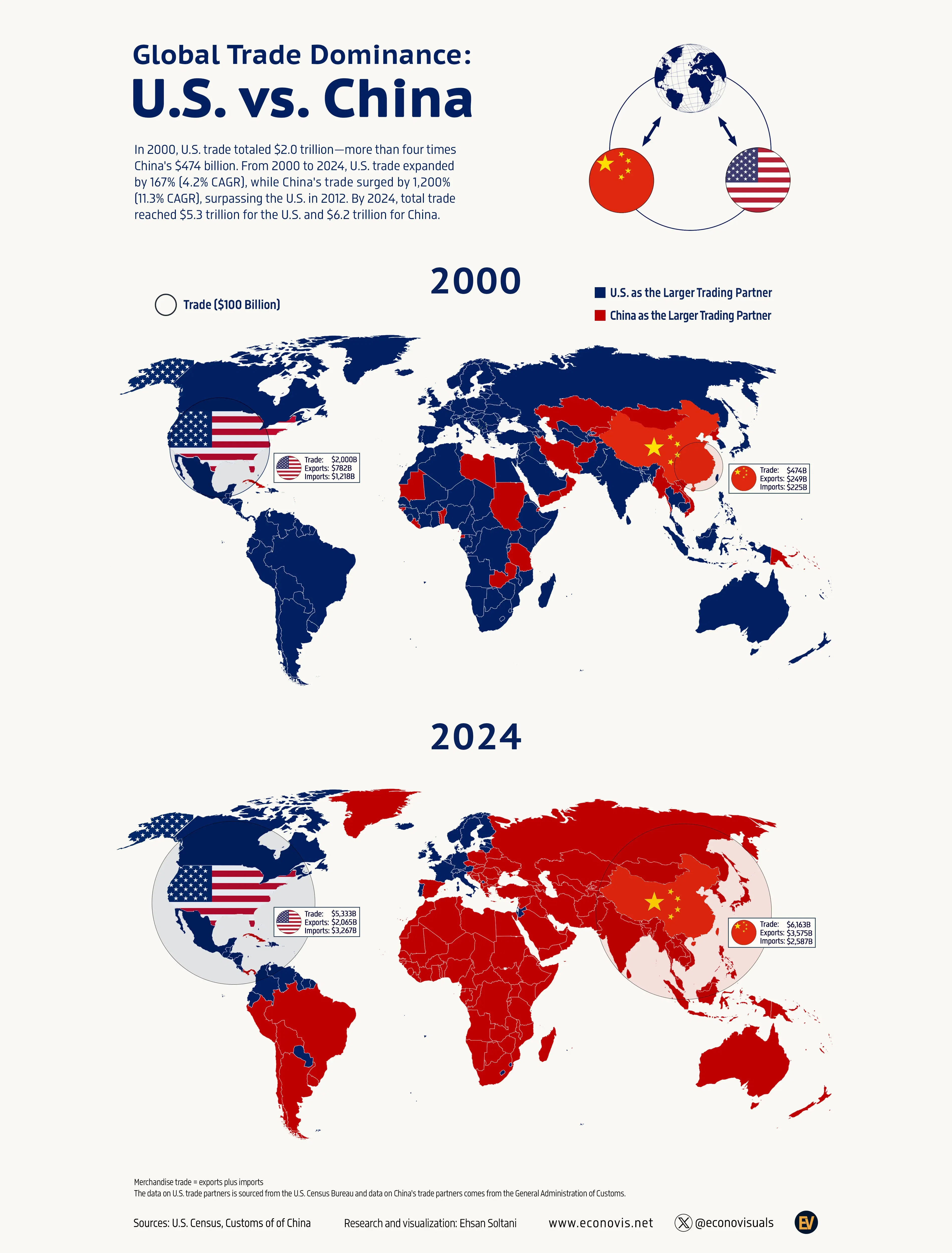
<p><img src="assets/gtd.png" alt="Trade Map" width="400" /></p>

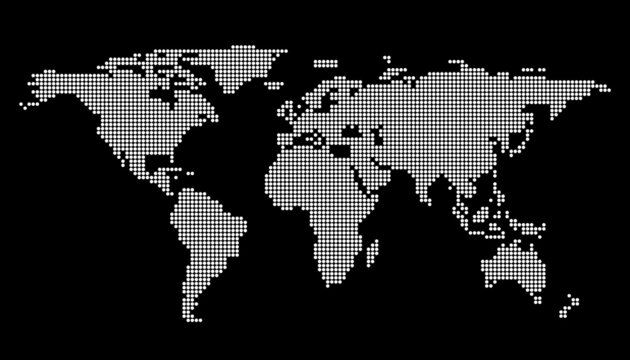
<p>This figure is underrated. It shows just how far China has come in flipping global trade dynamics in its favor. I like <a href="https://www.visualcapitalist.com/charted-chinas-exports-by-region-2000-2022/">this one</a> too.
Countries rich in key resources (like cobalt from the DRC or copper from Chile) often benefit from smoother visa processes and diplomatic perks. Same, manufacturing hubs like Vietnam or Malaysia get targeted outreach through eased travel policies.
Also, we’ve seen public figures openly praising China, and even <a href="https://www.scmp.com/news/china/diplomacy/article/3304034/china-hails-us-youtube-star-who-racks-10-million-views-beijing-shanghai-streams">rewarded by the authorities</a>. It’s not random. It feels like the beginning of a bigger wave of soft power. I’m curious to see how far it goes, how much it can reshape global perceptions and what that means for foreign relations in the long run.
ngl, this paragraph might not be super relevant, its just me reading on the internet and personal impressions.</p>

<p>I need someone to mansplain economics and politics to me for an hour a week.</p>

<p><span style="color:white">  Anyway, here’s your sign to book that flight. </span></p>]]></content><author><name>Alexine Le Port</name></author><summary type="html"><![CDATA[]]></summary></entry><entry><title type="html">advertising is evil</title><link href="https://jalexine.github.io/advertising-is-evil.html" rel="alternate" type="text/html" title="advertising is evil" /><published>2024-08-08T00:00:00+00:00</published><updated>2024-08-08T00:00:00+00:00</updated><id>https://jalexine.github.io/advertising-is-evil</id><content type="html" xml:base="https://jalexine.github.io/advertising-is-evil.html"><![CDATA[<p>After watching the <a href="https://x.com/lindayaX/status/1820838625245880634">video posted by Linda Yaccarino of Twitter on X</a>, I was inspired to write about advertisements.</p>

<p>Here are some initial thoughts.</p>

<p>Ads have always been a part of our daily lives, it made me struggle almost every single day of my life. But in recent years, there’s been a significant shift in how they are presented to us. This change is largely due to the integration of advanced algorithms/AI into the advertising industry.
In the past, advertisements were universal. Everyone would experience the same diffusion of content, provided they were in the same place (virtually or in real life). The content was designed to appeal to the broadest possible audience. 
In the 20th century, due to massive industrialization, industry needed to increase consumer spending so they started to use psychological techniques like <a href="https://en.wikipedia.org/wiki/Sublimation_(psychology)">sublimation</a>, <a href="https://convertica.org/the-power-of-scarcity-marketing/#:~:text=The%20Scarcity%20Principle%20is%20a%20marketing%20tactic%20that%20capitalizes%20on,a%20product%20in%20the%20market.">scarcity</a>, <a href="https://www.usherettetrays.com/using-conditioning-and-positive-reinforcement-to-help-build-your-brand/#:~:text=Positive%20reinforcement%20is%20all%20about,their%20loyalty%20to%20your%20brand.">positive reinforcement</a>, <a href="https://www.openpr.com/wiki/authority-marketing">authority</a>, <a href="https://en.wikipedia.org/wiki/Sex_in_advertising">sex sells</a> and so on.. Noticed that content was designed to appeal to the broadest possible audience.</p>

<p>All these psychological tricks make it nearly impossible for us to escape ads. Even if you think you’re strong and immune to them, nope, it doesn’t work that way.</p>

<p>without transition, <a href="https://www.amazon.com/9-99-Novel-Frederic-Beigbeder/dp/0330490079">I liked this book</a></p>

<h2 id="wow-ads-changed-"><span style="color: white;">Wow ads changed </span></h2>
<p>With the integration of sophisticated (though not yet perfect) algorithms into ads, the ads displayed to us have changed. Companies like Google, <a href="https://www.youtube.com/watch?v=ZspR5PZemcs">Netflix</a> or Facebook have developed systems that analyze our data to deliver personalized advertisements. These algorithms consider our browsing history, search queries, online purchases, and even our social media activity to determine which ads are most likely to resonate with us.</p>

<p>This personalization extends beyond the virtual world. <a href="https://medium.com/@matesanz.cuadrado/revolutionizing-sports-advertisement-with-generative-ai-2bd1c1134c6e">In sports games</a>, for example, we now see ads that vary depending on the country or even the region within a country. This localization is made possible through data analysis and AI, allowing advertisers to tailor their messages more precisely than ever before. One can imagine an amplification of this effect in the real world, hyperpersonalization, on an individual level.</p>

<p>Another significant change is the number of actors involved in advertising. Today, even individuals can participate in the advertising landscape. Social media influencers and content creators can reach large audiences and promote products directly to their followers. This democratization of advertising has its positive and negative aspects. On the positive side, it allows for more diverse voices and innovative content. On the negative side, it can lead to misinformation and a lack of regulation.</p>

<p>This shift raises several important questions. Knowing that ads are psychological tricks deployed on humans, what can be the consequences of this recent change?</p>

<h2 id="two-main-problems-"><span style="color: white;">Two main problems </span></h2>
<p>One concern is the impact on mental health. Thinking about the psychological impact of personalized ads brings me to mind the concept of madness. IMO, madness is characterized by the ability to perceive things that others cannot. I think this idea came from a philosophy book I read before, pls lmk if you have the reference. (thanks to Jonas, it might came from <a href="https://en.wikipedia.org/wiki/Madness_and_Civilization">Madness and Civilization</a>, Foucault) 
Anyway, this heightened perception might be akin to how personalized ads create a unique reality for each individual. If everyone is seeing different ads based on their data, are we each living in our own tailored bubble of reality? Personalized ads can create echo chambers, reinforcing our existing beliefs and preferences. This could limit our exposure to diverse perspectives and contribute to a more fragmented society. I think that playing with the line between our genuine interest and manufactured desire can lead to a perpetual feeling that we’re missing out on something, and dissatisfaction.</p>

<p>Another concern is the potential for increased manipulation. If advertisers can target us based on our specific interests and vulnerabilities, they might influence our decisions more effectively, leading to overconsumption or prioritizing wants over needs. Wow, this ad that I just saw! I never thought I needed that before, but it totally got me!
It can also lead to disinformation.</p>

<p>In the last years, we have seen ads represent a lot of minorities (Black people, LGBTQ+ communities, etc.). I’m not making a statement here, just noting that it’s similar to the representation during the <a href="https://sites.duke.edu/womenandadvertising/exhibits/women-in-advertising/from-housewife-to-superwoman-the-evolution-of-advertising-to-women/">emancipation of women</a>, post-war periods, etc.
Why am I talking about this? Here, I want to draw a parallel between ads and politics. Both share a symbiotic relationship with public opinion. In politics, laws can be formulated based on public opinion or the initiatives of politicians. Similarly, societies influence ads just as they influence politics. However, the reverse is also true. <a href="https://blog.hubspot.com/marketing/womens-razors-marketing">Ads can affects public opinion</a>. By proposing specific content, ads can subtly lead us to adopt certain ideologies without our conscious awareness. This is particularly dangerous because it shifts power from politicians to advertisers. We can see that recently, many people can loose their jobs if they don’t follow a certain ideology and even being cancel. While politicians, despite their flaws, are primarily concerned with human welfare, the advertising industry’s main focus is profit.</p>

<p>Intentionally, I didn’t mention that ads can be destructive because it’s obvious, and I didn’t want to sound pessimistic. However, it’s crucial to acknowledge that they can be particularly dangerous when it comes to targeting children.</p>

<p>I remain optimistic about ads. I think that the recent diversity of diferents actors in the advertising landscape is positive. It can allow to the user to “choose” a type of content he want to see. On platform like X, many people complain about a shitty feed experience, but this is often because they follow the wrong people. By following the right accounts, one can have a feed filled with arts or ml or porn? 
At a certain point, this ads system will might crash. We can already see the consequences with platforms like Tiktok and doomscrolling, which may push us to structure content regulation.</p>]]></content><author><name>Alexine Le Port</name></author><category term="example" /><summary type="html"><![CDATA[After watching the video posted by Linda Yaccarino of Twitter on X, I was inspired to write about advertisements.]]></summary></entry><entry><title type="html">alexine’s case against education</title><link href="https://jalexine.github.io/alexines-case.html" rel="alternate" type="text/html" title="alexine’s case against education" /><published>2024-05-31T00:00:00+00:00</published><updated>2024-05-31T00:00:00+00:00</updated><id>https://jalexine.github.io/alexines-case</id><content type="html" xml:base="https://jalexine.github.io/alexines-case.html"><![CDATA[<p>I recently read Scott Alexander’s article <a href="https://www.astralcodexten.com/p/a-theoretical-case-against-education">A Theoretical Case Against Education</a> and I wanted to share one part of my ‘theoretical case against education. </p>

<p>I believe that there’s a more nuanced explanation for why people forget much of what they learn in school, beyond what the <a href="https://en.wikipedia.org/wiki/Forgetting_curve">Ebbinghaus Forgetting Curve</a> can account for.</p>

<p>The issue of students forgetting what they learn in school is multifaceted, and an important factor often overlooked is the lack of interest. This lack of interest stems from both the school environment and the student themselves.</p>

<h2 id="pedagogical-methods-"><span style="color: white;">Pedagogical Methods </span></h2>

<p>This one is obvious, but traditional education methods often emphasize rote memorization and standardized testing, which fail to engage students deeply. In A <a href="https://eva.fcien.udelar.edu.uy/pluginfile.php/129978/mod_resource/content/2/A%20Mathematicians%20Lament.pdf">Mathematician’s Lament</a> the author introduces a great metaphor, despite his frequent rants and occasionally facetious arguments. He compares the superficial and mechanical way students often encounter mathematics to teaching painting by only allowing students to look at paint swatches and mix colors, without ever letting them actually paint anything or truly appreciate the beauty and depth of the discipline.</p>

<p>For example, I’ve previously studied literature, and I wonder : how are you supposed to learn if the only thing you have to do is comment on extracts of texts? Same, in computer science, how are you supposed to be motivated to learn by passing written exams?</p>

<p>OK I understand that teachers are often constrained by fixed and overloaded curricula, making it difficult for them to establish more effective approaches, but are students really only good at ingesting content without truly engaging with it?</p>

<p>This approach leads to superficial learning where information is quickly forgotten. Instead, educational practices should incorporate active learning, problem-solving, critical thinking, and proposing projects (choose by students themselves).</p>

<p>Moreover, teachers need training on how to effectively communicate in their courses. Merely having passion for a subject or a love for teaching doesn’t guarantee the ability to impart knowledge effectively. I mean it’s the most important part : THE COMMUNICATION. You can love being a teacher or the area you teach, sometimes it’s not enough. This part drives me personally crazy.  It’s like parenting : good intentions don’t count for much if you don’t know what you’re doing.</p>

<h2 id="interest-and-social-environment-"><span style="color: white;">Interest and Social Environment </span></h2>

<p>A student’s interest in a subject is significantly influenced by their social environment, both at school and outside of it. </p>

<p>First, Where does the interest come from? I think that : Interest isn’t <a href="https://fr.wikisource.org/wiki/L’Encyclopédie/1re_édition/GOUT">inherent</a>, but rather, it’s shaped by our education and environment, whether in opposition or not. Our curiosity and fascination for various subjects are not predetermined but are cultivated through learning and exposure to different experiences. It’s a dynamic and evolving process, influenced by our unique backgrounds and perspectives. I will come back later on that…</p>

<p>Peer influence is critical. If learning is not valued within a student’s social group, they are less likely to engage with their studies. <a href="https://www.youtube.com/watch?v=X6kWygqR0L8">Social mimicry is common</a>, and students often adopt the attitudes and behaviors of their friends. It’s like a government, how does it expect to works if it fails to be liked by its own participants… Schools need to cultivate environments where academic achievement is valued. That’s why, IMO, private schools are preferred by wealthy families.</p>

<p>On the other hand, if a student grows up in a family that values education in a specific subject, they are more likely to retain knowledge in those areas. For example, a student with parents who are mathematics teachers may have a heightened interest in pursuing a high-level degree in that field or a related one. Even if social mobility has increased, social reproduction remains strong. I would be curious to know what the current statistics are for on the work activities of children and their socio-professional origins, like the studies led by Bourdieu in <a href="https://www.sup.org/books/title/?id=2044">The Rules of Art</a>.</p>

<p>The case of a smart kid growing up in a family with low social and cultural capital is interesting because they often build their identity in opposition to their parents or school. This opposition can drive them to engage more deeply with educational material as a form of rebellion or self-assertion.Instead of ignoring the smart kids, they should learn from them.</p>

<h2 id="-about-the-smarter-kids-"><span style="color: white;"> About the smarter kids </span></h2>

<p>I kinda agree with the idea that “intellectuals put themselves in situations where they hear about things more often.” However, I believe that there’s more to it than just exposure to information. In my opinion, it’s more about the ability to integrate and connect new knowledge to previously acquired information across different subjects. </p>

<p>Intertextuality is the ability to make these connections and relate diverse concepts. For example, you can notice a pattern in one subject and apply it to another, or connect a concept from a book to a real-life situation, and yes, even Tiktok.</p>

<p>Critical thinking is crucial for retaining information. When students critically engage with material, they are more likely to remember it. Even if you don’t like something, if your critical thinking skills are highly developed, you’re more likely to remember why you didn’t like a particular book. Smarter people are often emotionally engaged with their critical thinking, which reinforces their memory of specific details.</p>

<p>I think we should prioritize teaching intertextuality and critical thinking skills to students. By doing so, they will be more interested in the material and will retain it for a more extended period.</p>

<p>My opinion comes from an europoor perspective. While our education system has same issues, at least it’s free. Unlike in the U.S. where students have to pay crazy high fees for college. It’s a scam</p>

<p>I think there’s hope for the future to change education, largely due to technological advancements. Our educational system has changed little, imo, since <a href="https://www.reddit.com/r/AskHistorians/comments/qxq6sw/is_it_true_rousseau_abandoned_his_5_children_what/">Rousseau’s time</a>. However, I wouldn’t want my future kids in a system like this. </p>]]></content><author><name>Alexine Le Port</name></author><category term="example" /><summary type="html"><![CDATA[I recently read Scott Alexander’s article A Theoretical Case Against Education and I wanted to share one part of my ‘theoretical case against education. ]]></summary></entry></feed>